
Somewhere in your design file sits a test you may never need to run again. FDA’s new draft on essential drug delivery performance characteristics says the quiet part out loud: for many delivery characteristics, you do not have to destroy finished devices to prove each lot is good. Control the performance where it is born, in design and manufacturing, and the document walks you through exactly how.
If you file autoinjectors, prefilled syringes, infusion pumps or inhalers, this draft decides which drug delivery data lands in your application and which stays inside your quality system. That split is where the money is. Here is the story it tells, section by section.
A New Name for an Old Job, and Why FDA Bothered
Start with the paperwork facts. This is a draft guidance, Revision 1, October 2026, issued under 21 CFR 10.115. It does not bind you; an alternative approach is allowed if it satisfies the applicable statutes and regulations. Now the substance.
The 2024 draft defined an essential drug delivery output (EDDO) as “the device drug-delivery design outputs necessary to ensure the drug delivery function.” The 2026 revision defines essential drug delivery performance characteristics (EDDCs) as “the key aspects of device drug-delivery that warrant development of and submission to FDA of performance information and data to ensure delivery of the intended drug dose to the intended delivery site.”
Read those two definitions side by side and the rename stops being cosmetic. Outputs is the vocabulary of engineering paperwork: what the device is built from, what dimensions it holds. Performance characteristics is the vocabulary of behavior: what the device actually does for the patient, measured at the level of the whole delivery system, and held “throughout the product lifecycle.” The scope did not move: devices regulated by CDRH and CBER, and the device constituent parts of CDER-led and CBER-led combination products. Delivery here spans product preparation, initiation, progression, and completion of dose delivery.
So one question decides everything else: which characteristics land on this list? That boundary is where the document earns its keep.
What Makes the List: System, Not Spare Part
Here is the rule in one sentence. An EDDC is a system-level delivery function that the device’s design controls, not a component spec and not a user’s technique. FDA demonstrates the line with its own examples, drawn from section IV and footnotes 28 through 30:
| Candidate characteristic | EDDC? | FDA’s reasoning |
|---|---|---|
| Glide force (prefilled syringe) | Yes | System-level delivery function |
| Break loose force (prefilled syringe) | Yes | Named with glide force as the syringe’s EDDCs (footnote 28) |
| Silicone quantity, needle inner diameter | No | Component-level aspects “already reflected in glide force” |
| Injection depth (manual syringe) | No | Depends on the user, not the device design |
| Injection depth (autoinjector) | Yes | The device, not the user, sets the depth |
| Injection time (autoinjector) | Yes | System-level; break loose and glide forces are lower-level aspects “already reflected in injection time” |
Look at the middle rows again, because they carry the lesson. The same physical dimension can sit on different sides of the line depending on the product type. Injection depth is a user technique with a plain syringe and a design-governed characteristic with an autoinjector. And component data does not vanish: it stays inside your quality system. It just stays out of the submission tables, because “for purposes of the submission, lower-level characteristics alone do not ensure intended drug delivery, and those data are generally not included for purposes of ensuring EDDC performance.”
Two questions sort any candidate characteristic into place:
The appendices turn the rule into ready-made checklists. Appendix B’s table rules whole categories out for autoinjectors: container closure integrity, biocompatibility, packaging integrity, drug visibility, and stopper height are “not a drug delivery function,” while audible and visual completion feedback are genuine EDDCs. Appendix C sorts candidate characteristics across product types into five delivery phases: delivery of intended dose, delivery to the target site, product preparation, initiation, progression, and completion. An on-body injector picks up adhesion force. A pen injector’s cap removal force sits in preparation. A metered dose inhaler carries priming and repriming. Every list is an example, not an automatic requirement.
Knowing what to measure is half the job. The other half is who gets to see the measurements, and in what language, and that is where the ground quietly moved.
The Rulebook Changed Underneath You: ISO 13485 Now Runs the Show
Until February 2026, FDA’s quality system rule spoke its own design-control dialect. The Quality Management System Regulation (QMSR), finalized at 89 FR 7496 on 2 February 2024, retired that dialect and replaced it with ISO 13485:2016. This draft guidance is one of the first places combination product sponsors meet the switch in practice, because it ties EDDC verification and validation directly to ISO 13485:2016 subclause 7.3.6 (verification) and 7.3.7 (validation), incorporated through 21 CFR 820.10(c) and 4.4(b)(1)(ii).
In plain terms: your drug delivery verification story is now written in ISO 13485 words. A design verification plan still speaking the old design-control vocabulary will read like it was borrowed from an older rulebook, because it was. The guidance also connects EDDC control to ICH Q12 established conditions (“related but do not directly align”), treats EDDCs as potentially analogous to critical quality attributes under ICH Q8(R2), and permits leveraging ISO 11608-1:2022 test information where the method fits.
Language, settled. The harder question follows naturally: how do you actually prove the dose arrives where it should, intact, every time?
Proving the Dose Arrives: First the Journey, Then the Patient
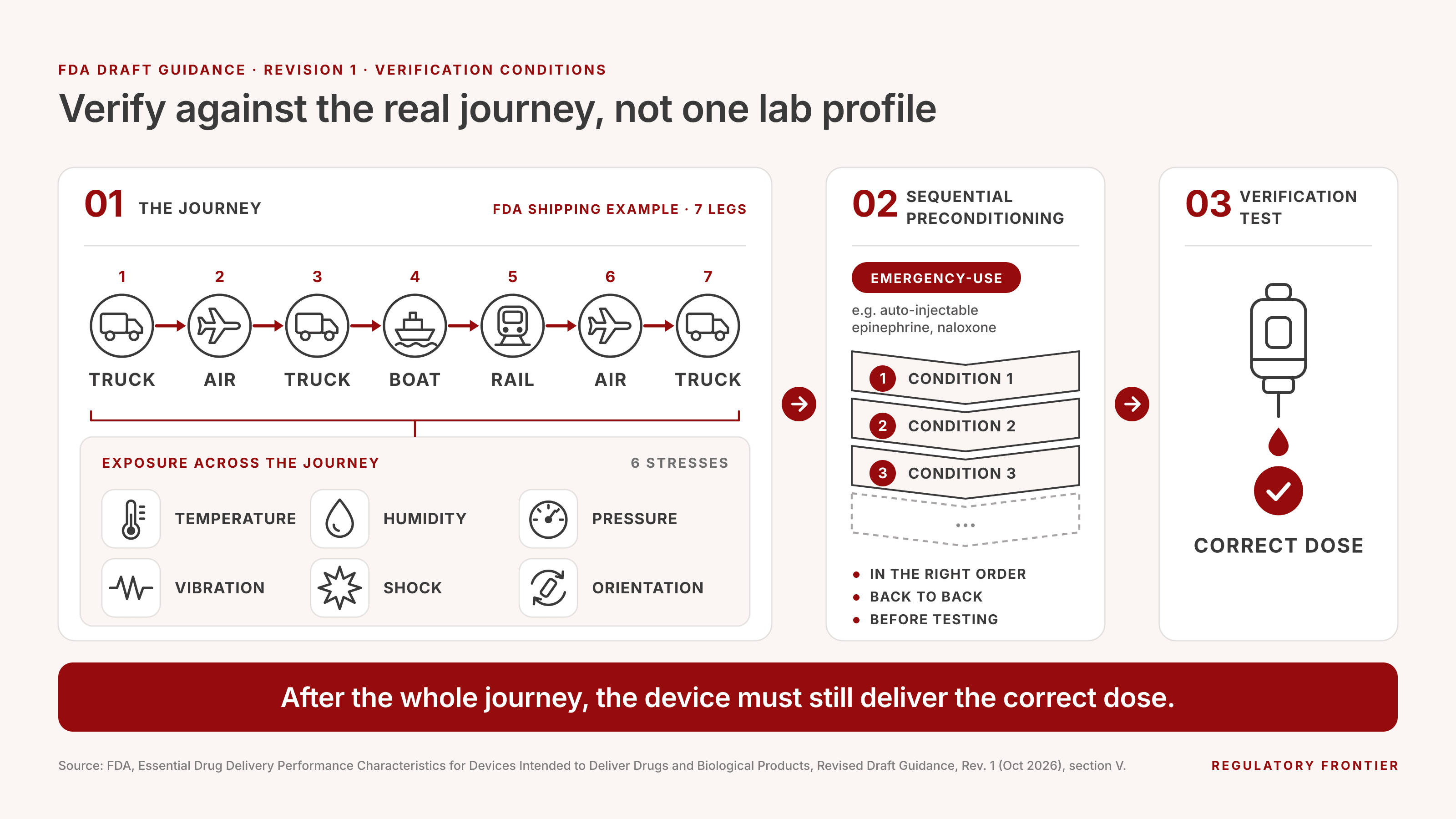
Section V names no test methods, and that restraint is deliberate. What it gives you instead is the list of conditions your proof must survive: temperature, pressure, humidity, vibration and shock, and physical orientation, across production, shipping, storage and preparation, plus use environments that run from hospitals to schools, homes and first-response settings. FDA’s shipping example is a journey, not a laboratory profile: “ground by truck to air, ground by truck to boat, ground by rail to air to ground by truck.”
When One Chamber Is Not Enough: Sequential Preconditioning
For emergency-use products, the bar rises. A failed deployment puts the patient at direct risk, so FDA expects the preconditioning steps applied back to back, in the right order, before testing. For products such as auto-injectable epinephrine or naloxone, the guidance says this sequence “is generally performed.” Sponsors of other products should consider it too, wherever delivery failure carries serious risk and the device is sensitive to environmental fluctuation.
Specifications themselves need defense beyond bench data. The guidance points to literature (injection site and patient population data for needle length) and anthropometric data (grip strength in specific patient populations), with acceptance criteria that are “clinically meaningful and appropriate to meet user needs.”
Reusable devices carry their own burden: simulated cleaning, reprocessing, and storage cycles before verification, kept carefully separate from human factors validation, which stays outside this document. Sampling plans should be risk-based with a statistical rationale, including justification for the number of lots. And age-sensitive characteristics need shelf-life or stability testing on the final finished product, with accelerated aging confirmed by real-time data.
The Clinical Half: Validation
Verification proves the device meets its specification. Validation proves the specification meets the user’s needs, and that proof usually lives in clinical evidence. The acceptable forms: clinical studies, PK/PD or bioequivalence studies, or literature, with EDDC-relevant endpoints written into the clinical protocol. FDA’s own example: an infusion pump submitted in an NDA validates its flow rate characteristic through effectiveness data, PK/PD data, and safety data such as occlusion rates and infusion site reactions.
Two pathway-specific rules matter. For ANDAs and 351(k) BLAs (the generic and biosimilar routes), applicants may need a side-by-side comparison of EDDC specifications or test results against the reference listed drug (the RLD), the original product the generic copies. Where differences exist, data must show therapeutic equivalence holds; FDA’s example turns on activation force. If the reference product is discontinued or the design differs, the route is a controlled correspondence or a pre-ANDA meeting. For 510(k)s, EDDCs are part of the technological characteristics compared against the predicate, and differences that raise new questions can pull in additional performance data, including clinical data.
Proof, in short, costs money. The next section is FDA telling you how to spend less of it.
The Way Out of Destructive Testing
Here was the fear that shaped this revision. If every identified delivery characteristic becomes a routine release test on finished devices, an actuated autoinjector becomes a sacrifice: every unit tested is a unit destroyed, and the economics collapse. Comments from the Combination Products Coalition, PhRMA, and ISPE pressed hard on exactly this worry after the 2024 draft.
The 2026 text answers with a risk-based, two-ended model. “A control strategy ensures each lot of the final finished product consistently meets its EDDC specification, and it can consist of control steps at different stages.” Upstream steps: in-process controls, control of process parameters, control of incoming materials, purchasing information. Downstream steps: lot release testing. The strategy rests on product and process understanding combined with risk management, drawing on design verification data and prior knowledge from manufacture of similar devices, with documentation depth matched to risk. Build a strategy that leans upstream and you owe FDA one more thing: a justification for why the upstream control is adequate for the final finished product.
Appendix D: The Template Worth Copying
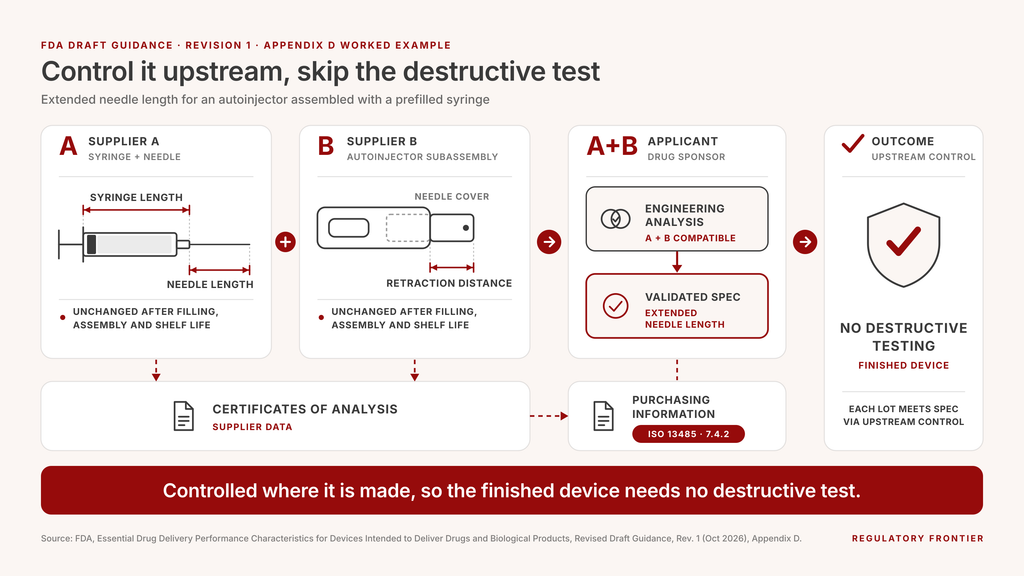
Appendix D walks that argument through one real EDDC: extended needle length for an autoinjector assembled with a prefilled syringe.
Supplier A manufactures the syringe and needle, so syringe length and needle length are controlled there, because those dimensions do not change after filling, assembly, or over shelf life. Supplier B manufactures the autoinjector subassembly, so needle cover retraction distance is controlled there, for the same reason. The applicant’s own engineering analysis shows the two suppliers’ controlled dimensions are compatible and validates the extended needle length specification, pulling supplier evidence such as certificates of analysis into purchasing information under ISO 13485 subclause 7.4.2.
No destructive finished-device testing appears anywhere in the chain. That is not a loophole. It is the template, and it is the single most valuable page in the document.
One question is left: which of all this lands on FDA’s desk, and which stays inside your building?
What Goes in the File, What Stays Home
Section VII splits the expectations by application type, and the differences are not subtle:
| Application | EDDC expectations (section VII) |
|---|---|
| IND / IDE | Development-stage data adequate for study subject safety; EDDC specifications, protocols, and bench data as design evolves; EDDC data from earlier studies can bridge between prototypes |
| PMA | Complete device description, functional components, manufacturing methods and controls, nonclinical laboratory study results |
| 510(k) | Device description, similarities and differences against comparable products with supporting data, and consideration of consequences of changes or new uses |
| De Novo | Complete device description and nonclinical laboratory study results |
| NDA / ANDA / BLA | Product description, final finished product specification data, manufacturing processes and controls, stability data |
Inside that table sits the asymmetry worth memorizing. For products requiring premarket approval, manufacturing control strategy information is required in the application. A 510(k) generally does not include control strategy information in the submission itself; the information demonstrating CGMP control of the manufacturing process must instead be available for FDA review during inspection. Your control strategy may never appear in the filing, and FDA will still ask for it. Build it to survive an auditor’s read, not a reviewer’s.
The guidance also sets presentation rules: EDDC summaries in the device description referencing the performance data section, test protocols and summary reports per EDDC for the final finished product, side-by-side comparison with earlier versions used in verification testing, and formatting under the eCTD v4.0 Technical Conformance Guide (June 2026) and FDA’s electronic submission templates for 510(k)s (October 2023) and De Novo requests (August 2024).
Post-market changes get the same discipline. Modifying the design or manufacturing process of an approved product triggers three duties: evaluate whether new EDDCs arise, analyze the impact on existing EDDC specifications, and provide a side-by-side comparison between the old and new specification sets. Unchanged EDDCs still need verification information, including stability and preconditioning, or a scientific justification for why performance will not drift. If the control strategy itself changes, you must show the new strategy is as effective as the original. And Section VIII points sponsors with novel platforms or boundary questions to early feedback through the Q-Submission Program, with the meeting background package carrying the proposed EDDCs and control strategy.
2024 Versus 2026, Line by Line
| Dimension | 2024 draft (89 FR 54470) | 2026 revision (91 FR 68523) |
|---|---|---|
| Core term | Essential drug delivery outputs (EDDO) | Essential drug delivery performance characteristics (EDDC) |
| Anchor concept | Device drug-delivery design outputs | System-level delivery performance, dependent on device design, held across the lifecycle |
| Quality system language | Legacy design controls framing | QMSR: ISO 13485:2016 subclauses 7.3.6 and 7.3.7 via 21 CFR 820.10(c) and 4.4(b)(1)(ii) |
| Preconditioning | General storage and transport conditioning recommendations | Explicit condition lists, multi-leg shipping sequences, sequential preconditioning for emergency-use products |
| Structure | Narrative body with general examples | Four appendices: A (prefilled syringe), B (autoinjector), C (EDDCs by product type), D (worked control strategy) |
| Industry friction answered | Silence interpreted broadly | Upstream control emphasis; component versus system boundary made explicit |
The table compresses the story: same concept, new anchor, sharper boundaries, and a worked example where the 2024 draft had silence.
Before 28 January: Three Doors Still Open
FDA asked for comments by 28 January 2027 “to ensure that the Agency considers your comment… before it begins work on the final version.” Three areas remain genuinely open, and each is worth a comment if you have the data.
- EDDC selection for novel platforms. The appendices cover prefilled syringes, autoinjectors, and common product types. Connected injectors, patch pumps with dosing algorithms, and on-body systems with electronics sit near the boundary between EDDCs, software function, and human factors. A Q-Submission beats an assumption here.
- Preconditioning burden. The sequential-preconditioning expectation for emergency-use products is stated as a general rule. Where your shipping data show the sequence adds no discriminating stress, that evidence belongs in a comment.
- Prior knowledge and platform leveraging. The guidance accepts prior knowledge from “similar devices” and ISO 11608-1:2022 data where methods fit, but does not define how much platform history carries a new drug-device pairing. Manufacturers with marketed platform data have standing to propose that boundary.
One internal audit closes the loop. Map your next submission against the five delivery phases in Appendix C: name the EDDC per phase, mark which are safety-critical, and check whether the specification justification cites clinical literature or anthropometric data the way section V expects. Components still sitting in finished-product release specifications should move upstream, and every verification protocol should be re-readable against the preconditioning language in section V. If the control strategy narrative would not survive Appendix D’s logic, that gap is cheaper to find now than in a review comment.
For the parallel device-side shift announced this autumn, see our coverage of FDA’s RASD premarket submissions draft: the same comment-window discipline, behind a different set of filing problems.
Frequently Asked Questions
What are essential drug delivery performance characteristics (EDDCs)?
They are the key aspects of device drug-delivery that warrant development of and submission to FDA of performance information and data to ensure delivery of the intended drug dose to the intended delivery site. EDDCs are system-level characteristics that depend on the device design, not on user actions, such as glide force for a prefilled syringe or injection time for an autoinjector.
What is the difference between the 2024 and 2026 draft guidances?
The 2026 revision renames essential drug delivery outputs (EDDOs) to essential drug delivery performance characteristics (EDDCs), shifts the anchor from design outputs to system-level performance under the QMSR, aligns verification and validation with ISO 13485:2016 subclauses 7.3.6 and 7.3.7, adds explicit sequential preconditioning expectations for emergency-use products, and adds four worked appendices including a full control strategy example.
Which products does the EDDC guidance cover?
Devices regulated by CDRH and CBER and device constituent parts of CDER-led and CBER-led combination products intended to deliver a human drug, including biological products. Examples include prefilled syringes, autoinjectors, on-body injectors, infusion pumps, nasal sprays, inhalers, nebulizers, and vaginal systems.
Does a 510(k) need to include the EDDC control strategy?
Generally no. Unlike NDAs, ANDAs, BLAs, and PMAs, a 510(k) submission generally does not include control strategy information itself. The information demonstrating control of the manufacturing process under CGMP must be available for FDA review during inspection, so it must exist in your quality management system even though it is not filed.
When do comments close on the revised draft?
Comments are due by 28 January 2027 to Docket No. FDA-2024-D-2560 on regulations.gov, so the agency considers them before beginning work on the final guidance.
Building a drug delivery file under the QMSR? See how Regulatory Frontier guides combination product teams through FDA, EU MDR, and CDSCO pathways.
Sources
FDA, Essential Drug Delivery Performance Characteristics for Devices Intended to Deliver Drugs and Biological Products, Revised Draft Guidance, Revision 1, October 2026 (fda.gov/media/179545/download)
Federal Register, 91 FR 68523, 30 October 2026, Docket No. FDA-2024-D-2560